Apply Now
Immersive experience took students’ analytical skills beyond classroom settings
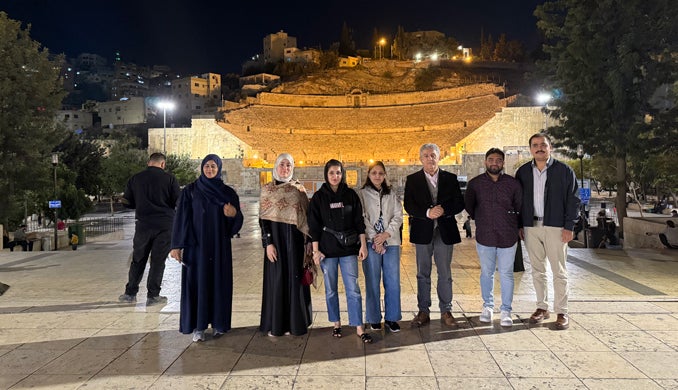
Graduate students from the College of Public Policy (CPP) recently completed a week-long field study visit to Jordan as part of the Master of Social Policy and Program Evaluation (MSPPE) program. The trip formed a central applied component, enabling students to practice the full cycle of evaluation planning, design, data collection, and reporting in a real-world governance context.
Supervised by Dr. Sultan Barakat, Professor, CPP, students conducted a mock evaluation of the EU-supported Nazaha program, implemented by the Al Hayat Centre–RASED in collaboration with local organizations. The initiative promotes transparency, citizen participation, and good governance across Jordan’s municipalities and civil society institutions.
During the field study, students applied key evaluation tools and methodologies introduced in class, including stakeholder mapping, interview protocol design, and data triangulation, to assess the effectiveness, efficiency, and relevance of Nazaha’s interventions. They also engaged with civil society organizations (CSOs) and municipal representatives in Amman, Zarqa, and Al Karak, conducting focus group discussions and key informant interviews to gather both qualitative and quantitative insights.
Reflecting on the experience, Dr. Barakat emphasized the importance of experiential learning in public policy education, stating: “The best way to cement theoretical understanding is to allow students to apply concepts and discover what works and what doesn’t in a real-life scenario. At CPP, we believe that practical application is what distinguishes our program from similar courses in other parts of the world. We are most grateful to Dr. Amer Bani Amer, Director General of Al Hayat Center, and to His Excellency Zaid Al-Lawzi, Jordan’s Ambassador to Qatar, for their generous support in facilitating this invaluable learning experience.”
The exercise emphasized ethical and professional standards in evaluation practice, effective stakeholder engagement, and evidence-informed decision-making. Students also examined how budgeting and resource allocation affect program outcomes and sustainability.
The visit culminated in a presentation of preliminary findings at RASED’s headquarters, where participants reflected on lessons learned. By linking classroom concepts with hands-on fieldwork, the experience enhanced students’ capacity to design, manage, and communicate evaluation results that inform policy decisions and foster accountability in governance.
Share:
Related News

Hamad Bin Khalifa University Lecture Explores Industrial Policy as an Engine of Diversification and Development
College of Public Policy Professor Appointed to International Review of the Red Cross Editorial Board
Hamad Bin Khalifa University’s College of Public Policy and International Public Policy Association Host Second International Winter School on Public Policy

Hamad Bin Khalifa University Workshop Examines Gulf States’ Contributions to Social Protection in Crisis Zones