Apply Now
QCRI/CSE paper advances research and innovation by addressing limitations of AI technologies and their applications to global challenges

A research paper, originating from doctoral work at CSE and an ongoing project at QCRI, developed through collaboration between the two institutions, has been accepted for presentation at the IEEE/CVF Conference on Computer Vision and Pattern Recognition (CVPR) 2025 in Nashville, USA.
Authored by Eng. Sara A. Al-Emadi, PhD candidate, CSE, and Research Associate, QCRI, alongside Dr. Ferda Ofli, Principle Scientist, QCRI, and Dr. David Yang, Professor, CSE, “Benchmarking Object Detectors under Real-World Distribution Shifts in Satellite Imagery” considers the role robust and generalisable artificial intelligence solutions play in detecting objects from satellite images in new and unseen environments. As part of their research, the team created a new tool called RWDS (Real-World Distribution Shifts), to test whether contemporary AI systems can still perform when conditions change. Scenarios included different climate zones and geographies, as well as damage to buildings after floods and hurricanes.
The authors’ findings demonstrate that even the most advanced AI systems struggle from significant performance drops under new situations. This, in turn, highlights the current limitations of AI in real-world applications and the importance of developing more robust and reliable systems for disaster response and climate monitoring. By sharing RWDS, the team also aims to advance AI generalization research and help industries develop technologies that perform reliably in critical, real-world situations.
“This research highlights the limitations of advanced AI in generalizing new and unseen environments, something humans do effortlessly,” said Eng. Sara A. Al-Emadi, the doctoral researcher leading the work. “If a two-year-old sees a giraffe in a cartoon and later at a zoo, they can easily recognize it as the same animal. AI models nevertheless struggle with such generalization. This demonstrates the challenges of deploying AI in critical areas, while offering researchers and industry a practical way to test and improve AI robustness in real-world applications.”
Dr. Ferda Ofli, co-author and advisor to the project, added: “This work is an example of how rigorous research can reveal real-world limitations in AI systems. RWDS provides a foundation for the community to build more resilient object detection models that can perform reliably under varied and unpredictable conditions.”
The IEEE/CVF Conference on Computer Vision and Pattern Recognition (CVPR) is recognized as one of the most competitive and prestigious venues in the fields of artificial intelligence and computer vision. In 2025, the conference accepted 2,878 papers from a total of 13,008 submissions. The present study was additionally featured in the workshop Domain Generalisation: Evolution, Breakthroughs, and Future Horizons (DG-EBF) held in conjunction with the conference.
Share:
Related News

Hamad Bin Khalifa University and Quantum Computing Inc. Expand Global Quantum Adoption Through New Framework Agreement
Hamad Bin Khalifa University Earns Scale-Up Grant for AI Scholar MaternaCare Project

Hamad Bin Khalifa University and Smithsonian Science Advance STEM Learning in Qatar
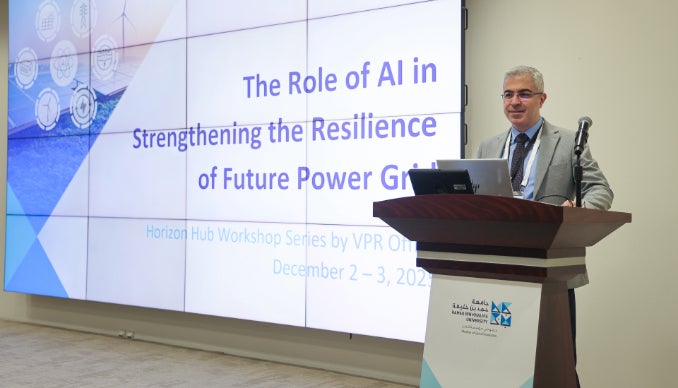
Experts Examine Important AI Solutions in Building Resilient and Sustainable Power Systems