Apply Now

Led by economist Dr. Ha-Joon Chang, discussions examined how robust policies can support economic diversification and national capacity-building
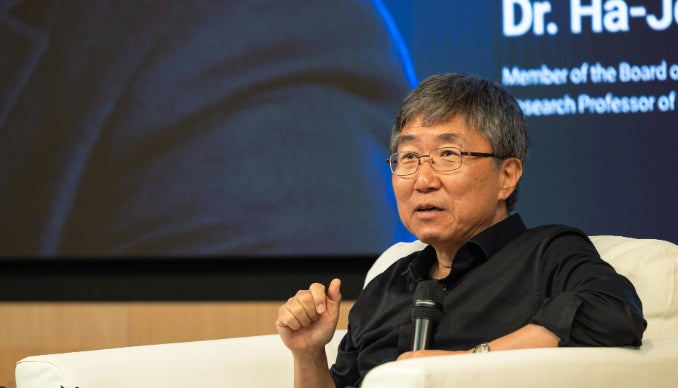
Hamad Bin Khalifa University hosted a lecture convened by the College of Public Policy (CPP) examining the role of industrial policy in driving economic diversification, strengthening productive capacity, and supporting long-term development. The discussion explored how strategic policy decisions can shape economic transformation, especially as countries seek to build more resilient, diversified economies.
Titled ‘Industrial Policy as an Engine of Diversification and Development,’ the lecture was led by Dr. Ha-Joon Chang, a leading economist specializing in industrial policy, development strategy, and how governments can drive economic transformation. A former faculty member at the University of Cambridge, a Member of the Board of Directors at Qatar Foundation, and currently a Professor of Economics at SOAS, University of London, Dr. Chang added a historical and institutional viewpoint to dialogues on economic development and conventional free-market approaches.
“Industrial policy is increasingly important to how countries think about economic diversification, national capabilities, and long-term resilience,” Dr. Logan Cochrane, Dean, CPP said. “At HBKU, we see value in bringing global expertise and interdisciplinary perspectives into dialogue with Qatar’s priorities, creating a platform that examines how policy choices can support sustainable economic development and shape the industries and capabilities of the future.”
Drawing on his advisory work with international organizations such as the United Nations, World Bank and national governments, Dr. Chang analyzed how targeted industrial policies can support more resilient and inclusive growth, particularly in smaller states. He noted that when sectors that generate the bulk of national income are highly capital-intensive, such as oil and gas, there is an imperative to use that revenue to create jobs by developing more labour-absorbing economic activities.
These considerations are particularly relevant to the Gulf Cooperation Council (GCC), where governments are pursuing economic diversification and building domestic capabilities beyond hydrocarbons. In this context, effective policies can support the development of new sectors, including high-technology industries, through coordinated public investment, infrastructure development, and creating enabling conditions for greater private sector participation.
For Qatar, these priorities are closely aligned with the country’s ongoing efforts to diversify its economy, strengthen national capabilities, and build a more knowledge-based economy. HBKU contributes to this agenda by providing a platform for informed dialogue on the policy choices shaping national development, connecting global economic perspectives with Qatar’s evolving priorities and development context.
Share:
Related News
College of Public Policy Professor Appointed to International Review of the Red Cross Editorial Board
Hamad Bin Khalifa University’s College of Public Policy and International Public Policy Association Host Second International Winter School on Public Policy

Hamad Bin Khalifa University Workshop Examines Gulf States’ Contributions to Social Protection in Crisis Zones
Arab Mayors Academy Training Concludes With Focus on Strategic Urban Resilience