Apply Now

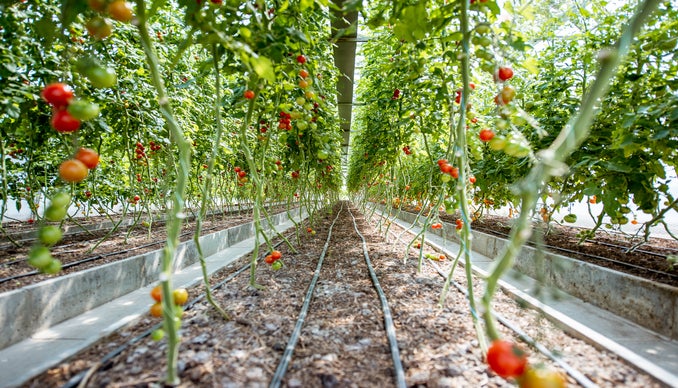
Qatar’s predominantly flat landscape and arid desert climate presents significant challenges for food production. Over the years, the situation has steadily improved with the implementation of sophisticated technology-backed agricultural methods, ensuring Qatar’s drive towards food security. In June this year, Youssef Khalid Al-Khulaifi, Director of the Agricultural Affairs Department at the Ministry of Municipality, reported that local farms currently produce almost 100% of vegetables sold during peak season. These include cucumbers, tomatoes, eggplants, and zucchinis, signifying a big step toward increasing local food production in Qatar by 2030.
To support food security, Qatar needs to adopt more sustainable farming methods and technology that use less water and energy, such as hydroponic and aquaponic farming. In this regard,the Qatar Environment and Energy Research Institute (QEERI) at Hamad Bin Khalifa University (HBKU) is actively developing systems to improve the efficiency of hydroponic and aquaponic farming facilities. These soil-free methods use significantly less water and are better suited to the country's dry climate.
Farming year-round in Qatar necessitates the use of greenhouses, which require electricity for cooling and lighting as well as a steady supply of clean water and nutrients. Such needs impose substantial financial and environmental burden on agricultural facilities. To overcome this challenge, QEERI is developing a system to help farms use these resources more efficiently, enabling better planning and decision-making.
At the center of its efforts is a resource management tool that uses sensors to monitor temperature, humidity, and water quality. The system collects data and sends it to a cloud system, where it analyzes and performs three tasks: providing real-time farm insights; recommending ways to conserve water and energy; and identifying the most cost-effective options. This platform aims to help Qatar meet its food goals while minimizing resource waste, thereby supporting Qatar’s National Food Security Strategy 2030. In addition, QEERI is developing a Farm Sustainability Index that measures a farm’s performance. The Index considers water and energy use, food production, financial viability, and environmental impact, helping farmers and planners identify areas for improvement.
QEERI’s platforms can help local farms grow more food and support agricultural policymaking. The latest government data shows that 98% of seasonal vegetables are now grown locally, reflecting the success of such efforts. Hydroponic systems, a key part of this progress, offer significant water-use efficiency, reducing consumption by up to 70-90% compared to traditional agriculture. While hydroponics requires energy for operation, the integration of renewable energy sources, particularly solar, helps to manage these demands sustainably. As a result, food prices remain competitive, and Qatar’s reliance on food imports decreases, supporting national goals for food security and environmental sustainability. While Qatar has already made significant progress, there is a need to sustain agricultural production year-round to further enhance food security, beyond just peak growing seasons. To support this objective, more farms will need access to such technology and systems that promote intelligent and sustainable farming.
Dr. Sa’d Abdel-Halim Shannak is a scientist at Hamad Bin Khalifa University’s (HBKU) Qatar Environment and Energy Research Institute (QEERI).
This piece has been submitted by HBKU’s Communications Directorate on behalf of its author. The thoughts and views expressed are the author’s own and do not necessarily reflect an official University stance.
Share:
Related News
QEERI Pioneering Patent Successes in Advanced Energy Conversion and Next-Generation 3D Printing
Qatar’s Innovative Solutions for Combating Desertification and Enhancing Sustainability