Apply Now

Participants from universities across Qatar and beyond engaged in projects ranging from language technologies to health diagnostics
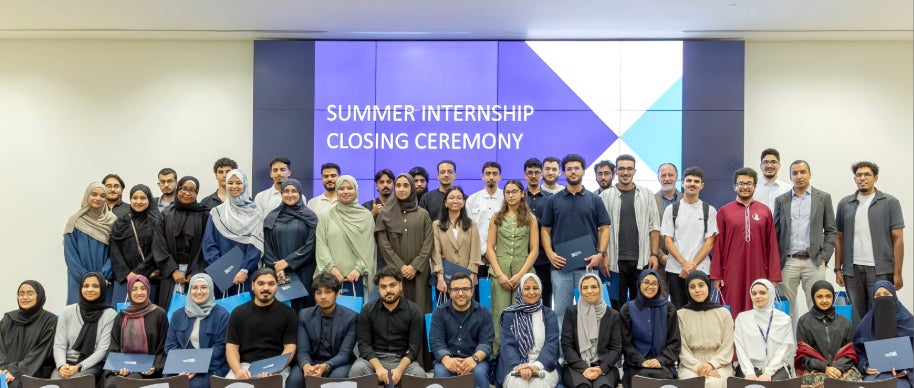
The Qatar Computing Research Institute (QCRI) held its Summer Internship Program for undergraduate and graduate students, offering hands-on research experience with researchers and professors and access to state-of-the-art research facilities.
An eight-week program provided a platform for students to explore research across several fields, including Arabic Language Technologies, Cybersecurity, Data Analytics, Social Computing, and Software Engineering. Participants were divided into two cohorts with alternating schedules to ensure dedicated mentorship and active engagement.
QCRI recorded around 108 students from eight Qatar-based universities, including Qatar University (QU), Carnegie Mellon University in Qatar (CMU-Q), Northwestern University in Qatar, University of Doha for Science and Technology, Arkansas State University Doha, and Ulster University Qatar. Students from international institutions also participated including Princeton University.
The projects covered a wide range of advanced computing research. AI and language technology projects explored domain-specialized and culturally grounded large language models (LLM) and dialect-aware understanding. Several initiatives focus on optimizing LLM capabilities, including multimodal tuning, test-time scaling, hallucination mitigation, robustness analysis, fact editing, and enhanced image understanding.
Other participants focused on cybersecurity, including threat-intelligence research, phishing-domain detection, model-response pattern analysis, and LLM watermarking. Health and bioinformatics projects covered applying AI to oral cancer diagnostics, federated learning, metabolomics, rare-disease detection and disease-prediction modeling. Vehicle-detection dashboards, explainable machine-learning methods, and innovative techniques for biological sequence encoding and multitask data generation were also explored.
Commenting on the program, Dr. Eman Fituri, Research Director, Educational Initiatives, stated: “These opportunities introduce students to a variety of careers and research interests and serve as a launch point for students to become highly sought-after employees or pursue graduate school. We will continue developing our research programs to engage more students through impact-driven projects, mentorship and internships.”
The program reflects the university’s role in developing the next generation of researchers and innovators equipped to address critical regional and global challenges.
Share:
Related News
Hamad Bin Khalifa University and Global Partners Advance Regional AI Landscape at MenaML Winter School
Hamad Bin Khalifa University’s Qatar Computing Research Institute Accepting Applications for Summer Internship Program
Hamad Bin Khalifa University Releases Enhanced Flagship Generative AI Platform
Hamad Bin Khalifa University and Boeing Convene Global Leaders to Advance Safe and Sustainable AI

Hamad Bin Khalifa University Spotlights Innovation and Expertise at World Summit AI 2025