Apply Now
Dr. Abdel-Fattah underscored the vast potential of writing in directing and inspiring action
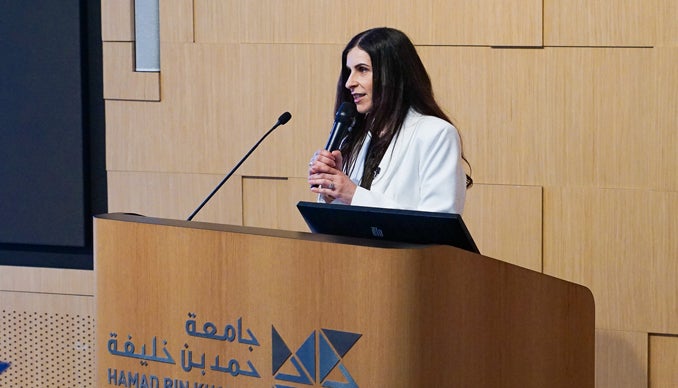
As part of its Muslim Women Writers Series, the Department of Language, Culture, and Communication within the College of Humanities and Social Sciences (CHSS) hosted an informative lecture titled ‘Creative Writing as a Practice of Freedom’.
Held at Education City’s Minaretein, guest speaker, Dr. Randa Abdel-Fattah, a Future Fellow in the Department of Sociology at Macquarie University, Sydney, Australia, shared insights on how her experiences as an academic, educator in primary and secondary schools, activist, writer, community organizer, and former lawyer have shaped her children's and young adult books.
During the talk, she drew from three of her books across different genres, including the bilingual Arabic-English award-winning 11 Words for Love and The Lines We Cross, as well as the recently-released Discipline. The latter is set in Sydney during Ramadan in 2021, a period when Israeli strikes on Gaza killed close to 300 people. The story was inspired by her lived experience, research and activism. It explores the traces of state violence on Palestinians and Muslims in law, media, education and academia.
Dr. Abdel-Fattah extensively discussed her approach to writing and reiterated the vast potential of writing to direct, inspire action and imagination. She emphasized that writing serves as a powerful medium for expressing original and unfiltered stories, while also inspiring change in today’s society.
Commenting on the lecture, Dr. Mahmoud Alhirthani, Assistant Professor, CHSS, said: “We are excited to have Dr. Abdel-Fattah here for this lecture. Her experience and success strengthen what we aim to accomplish with the Muslim Women Writers Series – highlighting underrepresented voices in this field. At CHSS, we aim to decolonize knowledge by challenging dominant canons and epistemologies that have historically marginalized Muslim women’s voices. Through initiatives such as this, we engage with Boaventura de Sousa Santos’ notion of the sociology of absences by bringing to the forefront those experiences and intellectual contributions that are often silenced or rendered invisible. In doing so, we hope to contribute to reshaping the narrative by creating and promoting works that accurately and critically represent Muslim women and their lived realities.”
This lecture highlights CHSS's commitment to amplifying the voices of Muslim women and promoting credible narratives that contribute to academic and societal discourse.
Share:
Related News
College of Humanities and Social Sciences Holds Advisory Board Meeting to Reflect on Successful Academic Year

Hamad Bin Khalifa University Advances Multilingual Education with Chinese Testing Center Accreditation
Hamad Bin Khalifa University’s College of Humanities and Social Sciences Hosts Student Research Forum