Apply Now
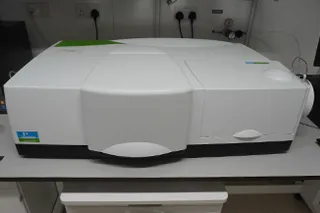
UV-VIS-NIR spectroscopy studies the interaction of matter with light in the ultraviolet, visible, and near-infrared regions (175 nm - 3300 nm) of the electromagnetic spectrum. It is widely used to measure the optical properties (transmittance, reflectance, and absorbance) of materials, mostly solids and liquids. It is extensively applied for characterization of a wide range of materials, such as thin films, coatings, glass, solar cells, and advanced materials research. The basic idea behind UV-Vis spectroscopy is to shine light of varying wavelengths through a sample and to measure the absorbance at each wavelength. Only the wavelengths corresponding to the ΔE for an electronic transition will be strongly absorbed. A UV-Vis spectrum plots absorbance (or transmittance) of the sample versus wavelength.