 Apply Now

The University’s engagement reflects Qatar’s broader efforts to promote health and innovation and contribute to global dialogue on autism
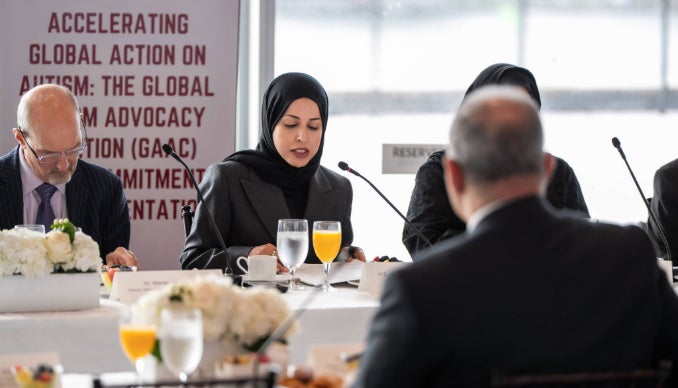
Hamad Bin Khalifa University (HBKU), a member of Qatar Foundation (QF), participated in a High-Level Breakfast held on the sidelines of the 81st Session of the United Nations General Assembly (UNGA).
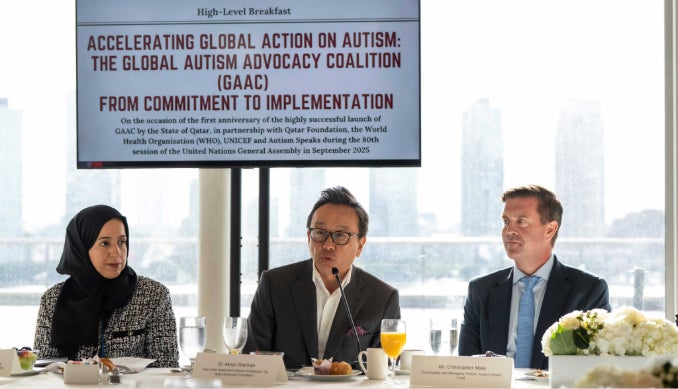
Hosted by the State of Qatar and the Global Autism Advocacy Coalition (GAAC), founded one year ago by QF, Autism Speaks, and UNICEF, with support from the World Health Organization - the gathering convened global stakeholders, health ministers, and international experts to address systemic gaps in autism services, policy, workforce development, and inclusion worldwide.
The members of the GAAC now also include Education Above All Foundation, the Bulat Utemuratov Foundation, Autism Impact Fund. The Ministry of Social Development and Family and Ministry of Public Health are leading the coalition’s agenda in Qatar.
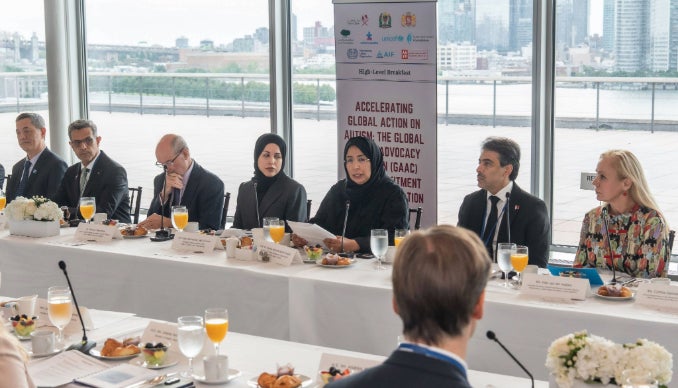
The event was attended by high-level Qatari delegates, including Her Excellency Dr. Hanan Mohamed Al Kuwari, Advisor to the Prime Minister for Public Health Affairs, His Excellency Fahad bin Hamad Al Sulaiti, Director General of Qatar Fund for Development, and Her Excellency Sheikha Alya Ahmed bin Saif Al-Thani, Permanent Representative of the State of Qatar to the UN; alongside ministers and representatives from 18 countries.
HBKU was represented by Dr. Dena Al-Thani Associate Professor, Co-Founder of the A-sense Center of Excellence, and Head of the Information and Computing Technology Division at the College of Science and Engineering (CSE), and Dr. Marwa Qaraqe Associate Professor, CSE and Co-Founder of the A-sense Center of Excellence. Their participation underlines HBKU’s contribution to Qatar’s efforts to advance research, knowledge, and evidence-based approaches to global health challenges.
As a national research university, HBKU contributes research that addresses autism across the lifespan and from multiple perspectives. Its six-year national prevalence study established autism at approximately one in 87 children in Qatar, while ongoing work is exploring eye-tracking and AI tools to identify early behavioral and speech indicators before formal diagnosis. The University has also examined parental age as a potential risk factor in nearly 2,000 Qatari children and studied the impact of public-health crises on autistic families.
Through its Neurological Disorders Research Center, the University studies the biological and genetic dimensions of autism, while the A-sense Center of Excellence develops technology-enabled solutions to support communication, early identification, and inclusion in line with Qatar’s National Action Plan for Autism.
This work is supported through collaboration across Qatar’s health, education, and community ecosystem, including Hamad Medical Corporation, the Ministry of Education and Higher Education, the Ministry of Public Health, alongside international institutions and organizations. HBKU also works across QF’s unique ecosystem that includes Sidra Medicine and Qatar Precision Health Institute, These partnerships enable HBKU to connect research with clinical and society needs, translating evidence into actionable clinical services and policy frameworks.

“Taking our place alongside global stakeholders at UNGA 81 underscores that scientific research cannot exist independently,” Dr. Dena Al-Thani commented. “The tools and research pioneered at HBKU are built to scale. By contributing precise biomedical data, human-centered engineering models and expertise to the GAAC, we are actively demonstrating how localized innovation can address complex health challenges from early screening to lifelong support,” she added.
HBKU’s research and collaborative model aligns closely with the GAAC’s focus on strengthening autism systems through scalable, data-backed interventions, building capacity, and increasing access to effective solutions. Its participation in the coalition reflects the University’s mission to generate knowledge with real-world impact, rooted in Arab and Islamic principles and contribute to national and international efforts addressing complex health and social challenges.
Share: