 Apply Now

Two-day gathering examined next-generation data center design, energy efficiency, and governance in supporting economic diversification and data sovereignty
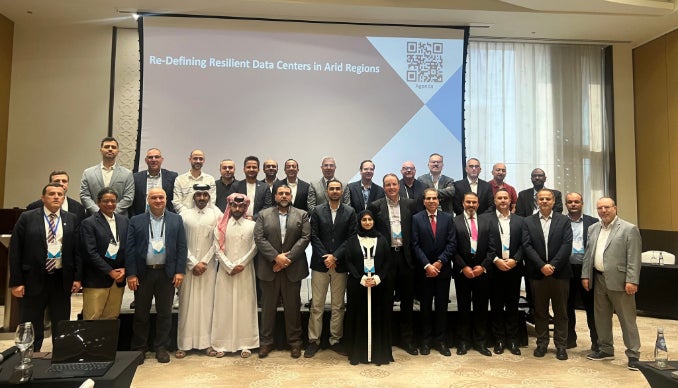
Hamad Bin Khalifa University (HBKU) hosted the “Horizon Hub Workshop: Re-Defining Resilient Data Centers in Arid Regions,” bringing together global experts from academia, industry, and government to investigate how next-generation data center infrastructure can support the increasing demands of artificial intelligence (AI) in arid environments.
The two-day workshop, supported by HBKU’s Office of the Vice President for Research (OVPR) through the Horizon Hub program, highlighted the industrial relevance of resilient and sustainable data centers as highly critical enablers of digital transformation, economic growth, and data sovereignty. The discussions focused on aligning technological innovation with environmental realities, placing resilient infrastructure as a national and regional priority.
Emphasizing the elevated significance of the topic, Dr. Eyad Ahmad Masad, Vice President for Research, HBKU, stated: “Data centers today are central to national development and global competitiveness. They power AI, advanced research, financial systems, as well as essential digital services. As Qatar consistently advances its digital transformation and expands its investments in AI, resilient and sustainable data centers will form a crucial cornerstone for progress across all sectors.”
Participants from leading institutions included several HBKU research entities, EPFL, Virginia Tech, National University of Singapore, University of Maryland, University of Albany, and the University of Arizona. They joined industry partners such as Syntys (Ooredoo), SEM Qatar, MEEZA, Doha Insurance Group, Eaton Corporation, Microsoft, NOKIA, Eridu AI, and the Qatar Football Association. Together, they engaged in keynote sessions, thematic breakout discussions, and expert panels focused on data center architecture, energy efficiency, thermal management, and data governance.
Addressing the role of AI in optimizing data center design, Dr. David Ebert, Chief AI and Data Science Officer and Associate Vice President of Research and Partnerships, University of Arizona, noted: “Everything in AI comes down to data and optimization. The way we’re approaching design optimization and considering all choices to improve materials is through machine learning and harnessing the power of AI algorithms.”
The workshop concluded with the development of immediately actionable recommendations and a collaborative roadmap aimed at advancing resilient, AI-enabled data center infrastructure tailored to the environmental realities of arid regions, reinforcing HBKU’s role as a hub for industry-engaged, impact-driven research.
Share: