 Apply Now

The partnership establishes a strategic framework for joint research, academic exchange, and collaborative initiatives
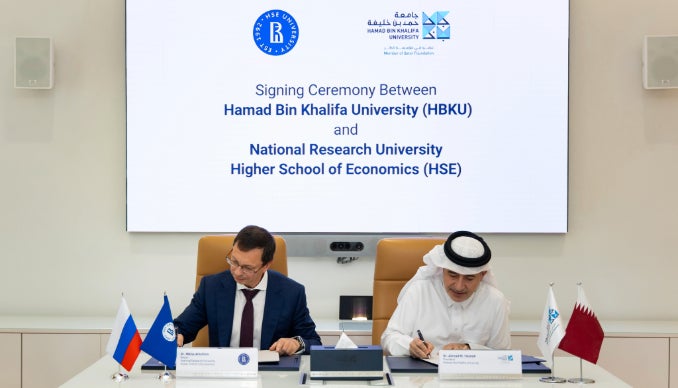
In line with its mission to expand and diversify global academic engagement and partnerships, Hamad Bin Khalifa University (HBKU) and Russia’s National Research University Higher School of Economics (HSE) have laid the foundations for a new long-term collaboration.
The agreement formalized by Dr. Ahmad M. Hasnah, President, HBKU, and Dr. Nikita Anisimov, HSE University Rector, brings together a leading Qatari research university and one of Russia’s pre-eminent institutions in economics and social sciences. The cooperation reflects both institutions’ commitment to advancing research excellence, and shaping a future driven by knowledge, discovery, and innovation.
The partnership specifically establishes and promotes academic, scientific, and cultural collaboration between HBKU and HSE University. Additionally, it is designed to continuously expand as areas of mutual interest evolve including exploring joint programs, research in areas including economics and social sciences as well as cultural exchange.
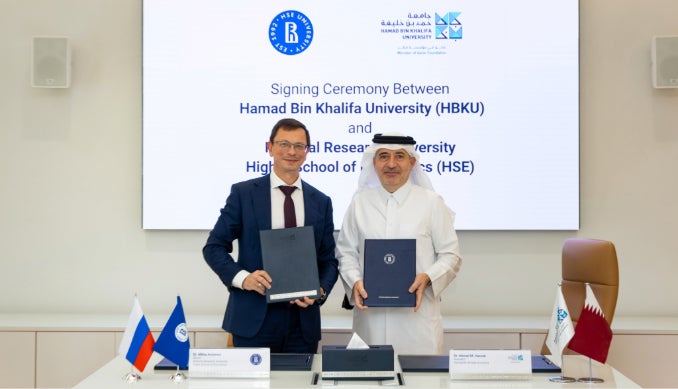
Commenting on the agreement, Dr. Hasnah stated: “Building on the strong relations between Russia and Qatar, we are proud to engage with international institutions like Russia’s HSE University that contribute to groundbreaking insights in areas of shared priority. With this agreement, we will further promote collaborative research and innovation, and support dialogues in areas of mutual interest that shape solutions to challenges important to Qatar, the region, and beyond.”
Dr. Anisimov in turn, commented: “This agreement embodies a balanced and forward-looking vision for Russian-Qatari cooperation. Our joint work with Hamad Bin Khalifa University will focus on practical academic programs in economics and the social sciences, designed to support shared priorities, foster mutual trust, and ensure a sustainable long-term partnership.”
HBKU continues to leverage strategic partnerships with major international institutions to produce scholarly contributions, real-world solutions, and meaningful change.
Share: