Apply Now
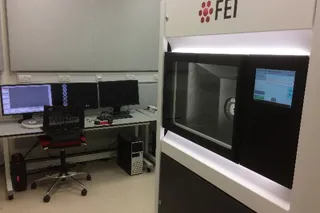
Transmission electron microscopy (TEM) is a microscopy technique in which a beam of electrons is transmitted through a specimen to form an image. The specimen is most often an ultrathin section less than 100 nm thick or a suspension on a grid. An image is formed from the interaction of the electrons with the sample as the beam is transmitted through the specimen. The image is then magnified and focused onto an imaging device, such as a fluorescent screen or a sensor, such as a scintillator attached to a charge-coupled device (CCD camera). Transmission electron microscopes are capable of imaging at a significantly higher resolution, enabling the instrument to capture fine detail—even as small as a single column of atoms. Transmission electron microscopy is a major analytical method in the physical, chemical, and biological sciences. TEMs find application in materials science, such as nanotechnology, semiconductor research, devices, and catalysis, and in biological sciences, such as cancer research, virology, bacteriology, and other fields.