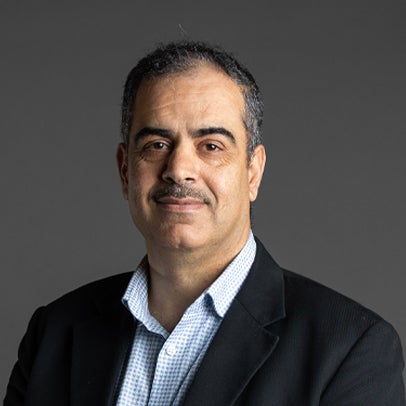
الدكتور نهاد العاجز

باحث رئيسي

أستاذ مشارك مساعد

البريد الإلكتروني

nalajez@hbku.edu.qa

الدكتور نهاد العاجز

باحث رئيسي

أستاذ مشارك مساعد

المؤهلات العلمية

PhD

MSc

الكيان

معهد قطر لبحوث الطب الحيوي

كلية العلوم الصحية والحيوية

القسم

مركز البحوث التطبيقية للسرطان

السيرة الذاتية

Dr. Nehad Alajez earned his PhD in tumour immunology from the University of Pittsburgh School of Medicine in USA, and subsequently completed his post-doctoral training at the Princess Margaret Cancer Center (University Health Network), a premier cancer research institute in Canada. His main research interest is to investigate the role of the Polycomb gene family and non-coding microRNAs in driving cancer progression and their potential utilization for targeted therapies. Dr. Alajez is a recipient of several prestigious awards and has published more than 100 articles in top-tier ISI-indexed journals including Blood, Cancer Research, Cell Death and Differentiation, Cell Death and Disease, Signal Transduction and Targeted Therapy, Molecular Therapy (family journals), EMBO Molecular Medicine, and in Science Translational Medicine. Dr. Alajez currently has close to 5000 citations and an h-index of 35 and i10-index of 74.

Prior to his current appointment, Dr. Alajez was appointed as the Associate Professor at King Saud University College of Medicine, Kingdom of Saudi Arabia. Dr. Alajez’s main research interests are focused on ‘translational oncology research’ with main emphasis on novel biomarker discovery and targeted therapeutics for breast cancers. In particular, Dr. Alajez’s team is studying noncoding RNAs (micoRNAs and lncRNAs) as disease and predictive biomarkers for patients’ response to therapy. Dr. Alajez has strong expertise in transcriptome analysis, noncoding RNAs, and biomarker discovery field and is currently ranked among the top 2% most cited scientist globally. He is a recipient of several major grants, including funding from Qatar National Research Fund, in addition to his editorial roles on several journals.


PhD

University of Pittsburgh, USA

2003

MSc

San Francisco State University, USA

1999

BSc

Islamic University of Gaza, Palestine

1995

Dr. Alajez main research interests are focused on precision medicine aiming at the discovery of novel tumour and circulating biomarkers for breast cancer diagnosis, prognosis, and therapy. Additionally, Dr. Alajez’s group is conducting CRISPR-Cas9 genomic screens to elucidate the role of miRNAs and lncRNAs in driving breast cancer survival and resistance to standard therapies.

  • Identification of molecular signatures predictive of pathological complete response to neoadjuvant therapy in breast cancer.
  • Identification of circulating miRNAs as diagnostic and predictive biomarkers for breast cancer.
  • Transcriptomic profiling of breast cancer for diagnostic
  • prognostic
  • and therapeutic applications.
  • CRISPR-Cas9 genomic screen to identify novel therapeutic vulnerabilities in breast cancer.

Principal Investigator

Translational Oncology Research Center, Qatar Biomedical Research Institute

2022 - Present

Senior Scientist

Translational Cancer and Immunity Center, Qatar Biomedical Research Institute

2018 - 2022

Associate Professor

College of Medicine, King Saud University

2015 - 2018

Assistant Professor

College of Medicine, King Saud University

2011 - 2015

Vishnubalaji R, Shaath H, Al-Alwan M, Abdelalim EM, Alajez NM. Reciprocal interplays between MicroRNAs and pluripotency transcription factors in dictating stemness features in human cancers. Semin Cancer Biol 2022;87:1-16.

Vishnubalaji R, Abdel-Razeq H, Gehani S, Albagha OME, Alajez NM. Identification of a Gene Panel Predictive of Triple-Negative Breast Cancer Response to Neoadjuvant Chemotherapy Employing Transcriptomic and Functional Validation. Int J Mol Sci 2022;23(18).

Shaath H, Vishnubalaji R, Elango R, Kardousha A, Islam Z, Qureshi R, et al. Long non-coding RNA and RNA-binding protein interactions in cancer: Experimental and machine learning approaches. Semin Cancer Biol 2022;86(Pt 3):325-45.

Vishnubalaji R, Alajez NM. Transcriptional landscape associated with TNBC resistance to neoadjuvant chemotherapy revealed by single-cell RNA-seq. Mol Ther Oncolytics 2021;23:151-62.

Shaath H, Vishnubalaji R, Elango R, Khattak S, Alajez NM. Single-cell long noncoding RNA (lncRNA) transcriptome implicates MALAT1 in triple-negative breast cancer (TNBC) resistance to neoadjuvant chemotherapy. Cell Death Discov 2021;7(1):23.

Elango R, Vishnubalaji R, Shaath H, Alajez NM. Molecular subtyping and functional validation of TTK, TPX2, UBE2C, and LRP8 in sensitivity of TNBC to paclitaxel. Mol Ther Methods Clin Dev 2021;20:601-14.

Alajez NM. COVID-19: complexity of disease severity revealed by systemic and localized single cell immune atlas. Signal Transduct Target Ther 2021;6(1):156.

Vishnubalaji R, Shaath H, Elango R, Alajez NM. Noncoding RNAs as potential mediators of resistance to cancer immunotherapy. Semin Cancer Biol 2020;65:65-79.

Shaath H, Vishnubalaji R, Elkord E, Alajez NM. Single-Cell Transcriptome Analysis Highlights a Role for Neutrophils and Inflammatory Macrophages in the Pathogenesis of Severe COVID-19. Cells 2020;9(11).

Sasidharan Nair V, Toor SM, Taouk G, Pfister G, Ouararhni K, Alajez NM, et al. Pembrolizumab Interferes with the Differentiation of Human FOXP3(+)-Induced T Regulatory Cells, but Not with FOXP3 Stability, through Activation of mTOR. J Immunol 2020;204(1):199-211.

Hanieh H, Ahmed EA, Vishnubalaji R, Alajez NM. SOX4: Epigenetic regulation and role in tumorigenesis. Semin Cancer Biol 2020;67(Pt 1):91-104.

Elango R, Alsaleh KA, Vishnubalaji R, Manikandan M, Ali AM, Abd El-Aziz N, et al. MicroRNA Expression Profiling on Paired Primary and Lymph Node Metastatic Breast Cancer Revealed Distinct microRNA Profile Associated With LNM. Front Oncol 2020;10:756.

Vishnubalaji R, Shaath H, Elkord E, Alajez NM. Long non-coding RNA (lncRNA) transcriptional landscape in breast cancer identifies LINC01614 as non-favorable prognostic biomarker regulated by TGFbeta and focal adhesion kinase (FAK) signaling. Cell Death Discov 2019;5:109

Vishnubalaji R, Elango R, Al-Toub M, Manikandan M, Al-Rikabi A, Harkness L, et al. Neoplastic Transformation of Human Mesenchymal Stromal Cells Mediated via LIN28B. Sci Rep 2019;9(1):8101

Elango R, Vishnubalaji R, Manikandan M, Binhamdan SI, Siyal AA, Alshawakir YA, et al. Concurrent targeting of BMI1 and CDK4/6 abrogates tumor growth in vitro and in vivo. Sci Rep 2019;9(1):13696

Hamam R, Hamam D, Alsaleh KA, Kassem M, Zaher W, Alfayez M, et al. Circulating microRNAs in breast cancer: novel diagnostic and prognostic biomarkers. Cell Death Dis 2017;8(9):e3045

Vishnubalaji R, Hamam R, Yue S, Al-Obeed O, Kassem M, Liu FF, et al. MicroRNA-320 suppresses colorectal cancer by targeting SOX4, FOXM1, and FOXQ1. Oncotarget 2016;7(24):35789-802.

Hamam R, Ali AM, Alsaleh KA, Kassem M, Alfayez M, Aldahmash A, et al. microRNA expression profiling on individual breast cancer patients identifies novel panel of circulating microRNA for early detection. Sci Rep 2016;6:25997.

Vishnubalaji R, Hamam R, Abdulla MH, Mohammed MA, Kassem M, Al-Obeed O, et al. Genome-wide mRNA and miRNA expression profiling reveal multiple regulatory networks in colorectal cancer. Cell Death Dis 2015;6(1):e1614.

Ito E, Yue S, Moriyama EH, Hui AB, Kim I, Shi W, et al. Uroporphyrinogen decarboxylase is a radiosensitizing target for head and neck cancer. Sci Transl Med 2011;3(67):67ra7.

Alajez NM, Lenarduzzi M, Ito E, Hui AB, Shi W, Bruce J, et al. MiR-218 suppresses nasopharyngeal cancer progression through downregulation of survivin and the SLIT2-ROBO1 pathway. Cancer Res 2011;71(6):2381-91.

Alajez NM, Shi W, Hui AB, Yue S, Ng R, Lo KW, et al. Targeted depletion of BMI1 sensitizes tumor cells to P53-mediated apoptosis in response to radiation therapy. Cell Death Differ 2009;16(11):1469-79.

Alajez NM, Schmielau J, Alter MD, Cascio M, Finn OJ. Therapeutic potential of a tumor-specific, MHC-unrestricted T-cell receptor expressed on effector cells of the innate and the adaptive immune system through bone marrow transduction and immune reconstitution. Blood 2005;105(12):4583-9.

  • 2022, Qatar Biomedical Research Institute top publishing.
  • 2022, Qatar Biomedical Research Institute top external received funding. 
  • 2022, among top 2% most cited scientists worldwide.
  • 2021, among top 2% most cited scientists worldwide.
  • 2021, Qatar Biomedical Research Institute highest publication award.
  • 2010, Scholar-in-Training Award, American Association of Cancer Research.
  • 2007, Excellence in Radiation Research for the 21st Century Award, Canadian Institute for Health Research.
  • 2004, Scholar-in-Training Award, American Association of cancer research.
  • 2001, DOD pre-doctoral training Award on Breast Cancer Research.
  • 1999, San Francisco State University distinguished achievement award for academic excellence.
  • 1997, Fulbright Scholarship.