
 Apply Now
Overview
Advancing sustainable desalination through optimized reverse osmosis, improved brine treatment, and mineral recovery to strengthen water security and resource efficiency.
Projects
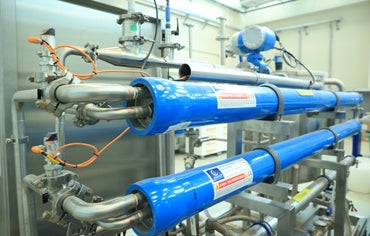
Qatar and the Gulf face unique desalination challenges due to extreme seawater temperatures, high salinity, biofouling, scaling, and the presence of naturally occurring isotopes. The Smart and Integrated Desalination project aims to develop, integrate, and validate advanced technologies from seawater intake to freshwater production, tailored for Gulf-specific conditions.
The project combines marine-friendly smart intake systems with real-time bio-monitoring and data-driven early warning capabilities, enabling dynamic selection of optimal pretreatment strategies (UV, Plasma, chlorination, filtration). Pretreatment innovations include surface-modified NF and in-house developed UF membranes, advanced DAF optimization, and novel ion exchange resins for selective isotope removal.
Core desalination will be assessed across RO, MED, MD, and FO, individually and in hybrid configurations, followed by pilot-scale validation. Emerging technologies such as plasma desalination, renewable-driven membrane distillation, and thermoplastic corrosion-resistant materials will also be investigated.
Comprehensive techno-economic assessment (TEA) and life cycle assessment (LCA) will quantify sustainability, cost-effectiveness, and environmental impacts, ensuring a clear commercialization pathway.
Through a 3-year, multi-WP approach leveraging HBKU’s state-of-the-art facilities, this project will deliver a validated, integrated desalination blueprint optimized for Gulf conditions, improving water security, lowering costs, and reducing environmental impacts.
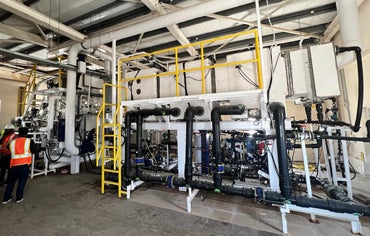
Qatar heavily depends on seawater desalination from the Arabian Gulf to meet its national potable water needs. A byproduct of this process is brine, which is often discharged back into the sea. However, this reject brine poses environmental risks due to its high levels of total dissolved solids (TDS), concentrated chemicals, temperature-resistant microorganisms, and potentially harmful toxins. For instance, brine produced through Multi-Effect Distillation (MED) has been shown to contain a TDS of approximately 70 g/L.
Globally, various brine management strategies, such as deep-well injection and evaporation ponds, have been implemented to mitigate these risks. In Qatar, it is believed that brine undergoes some level of treatment before being discharged into the sea. Yet, because brine is also rich in minerals and salts, it represents an opportunity for resource recovery that could support local industrial demand.
For example, the production of high-quality brine can provide a sustainable feedstock for Qatar’s caustic soda industry and open opportunities for future soda ash production, reducing import dependence. Recovery of high-purity salts and minerals such as calcium (Ca), magnesium (Mg), and strontium (Sr) would strengthen synergies between the water and chemical sectors, enhancing both economic viability and resource efficiency.
This project will advance these concepts at Technology Readiness Level (TRL) 4–5, validating technologies at the bench scale and testing them with real brine to demonstrate feasibility under relevant conditions.