 Apply Now
Overview
This initiative focuses on advancing innovative technologies and solutions that address the unique challenges of desert environments.
Projects

The REAM (Advancing Renewable Energy Applications and Markets for Smart Cities) project, supported in part by the AICC grant AICC05-0508-230001 with partners CSE, CIS, OIIR, Inventus Power, KAHRAMAA, Vakıf Katılım, Maltepe University, Belek University, and CCW Technology (Turkey), develops advanced analytics, machine learning models, and decentralized trading platforms to revolutionize renewable energy markets. In parallel, it advances green finance mechanisms and green project assessment frameworks to guide sustainable investments. By integrating PV performance data, resilience modelling, and policy alignment, REAM equips smart cities with tools to achieve greater sustainability, efficiency, and economic growth.
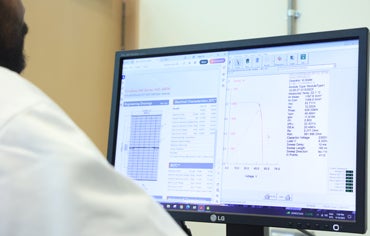
The proposed research project introduces an integrated framework that combines PV energy yield forecasting, sustainability assessment, and predictive diagnostics tailored specifically for desert climates. The project creates new datasets, models, and decision tools tailored to hot/dry conditions by combining five synergistic WPs that seamlessly integrate advanced materials validation, autonomous operation, AI-driven analytics, and life-cycle assessment into a unified decision-support system.
The work is structured into five synergistic work packages (WPs):
- Technology Benchmarking and Environmental Degradation Modeling: Field testing and accelerated degradation modeling of emerging PV technologies (TOPCon, HJT, PERC, IBCM, and perovskite–Si tandem), mounting configurations (HSAT, vertical, fixed), and innovative applications (floating PV, Agri-PV, and building-integrated).
- Autonomous PV System Monitoring and Operation: Development of AI-based platforms for autonomous monitoring and robotic cleaning, informed by real-time sensing and soiling forecasts from the Environment Center.
- Materials-Integrated Smart Coatings and Module Design: Validation of anti-soiling and IR-reflective coatings developed by the materials unit, assessing their impact on yield, cleaning frequency, and mechanical degradation.
- PV Failure Analysis and Predictive Diagnostics: Conducts root cause failure analysis and develops AI-driven predictive maintenance systems using real-time monitoring and digital twin technologies to anticipate and mitigate system faults.
- Integrated Energy Yield Analysis and Sustainability Assessment: Combines energy yield forecasting with comprehensive life-cycle assessment (LCA), and techno-economic analysis (LCOE) to provide a holistic evaluation of PV performance, reliability, and environmental impact under desert conditions.
The project explores long-term energy transition scenarios for the State of Qatar, using two energy systems models: Qatar TIMES and MUSE Qatar, as the main analytical tools, complemented by other quantitative and qualitative research methods. The models represent all energy, water, and environmental technologies relevant to Qatar (for more details, please check WP1), and project the evolution of the energy system over several decades. The aim of the project is two-fold:
- To generate new policy-relevant insights that can inform government and other stakeholders, particularly in relation to climate change policy and long-term energy infrastructure planning.
- To quantify the contribution that energy, water, and environmental technologies can make, both in terms of cost and emissions savings, and inform national research and innovation policies based on this evidence.
Both Qatar TIMES and MUSE Qatar require gathering, processing, and updating large amounts of data; this is done in WP1. While WP2 focuses on updating and further developing Qatar TIMES as required by the new scenarios explored. WP3 generates, analyses, and disseminates Qatar TIMES model results. As Qatar’s economy heavily depends on the export of fuels, chemicals, and metals. WP4 analyses the impact of international market changes, particularly the development of markets for clean fuels, chemicals, and metals, on the evolution of Qatar’s energy system. WP5 focuses on the use of MUSE Qatar to explore the same scenarios studied in Qatar TIMES and, by comparing and contrasting the results of the two models, generate further policy-relevant insights.