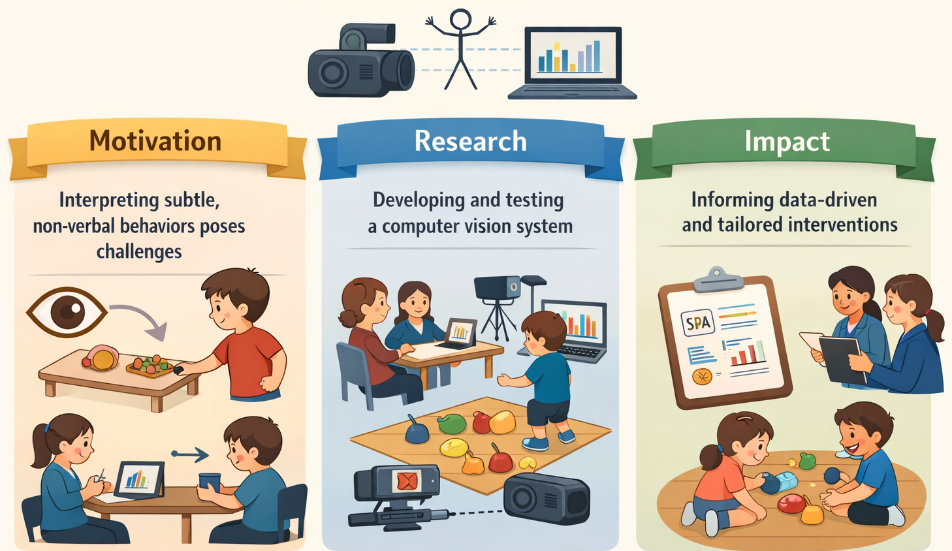

Motivation
Preference assessments in autism often depend on therapists interpreting subtle non-verbal behaviors, such as gaze, hesitation, body orientation, and reaching, which can make preferences hard to identify consistently. This project addresses that challenge by using computer vision to quantify these behaviors and reduce interpretation bias in choice assessment.
Research
The project has three phases:
- Explore current SPA practices through specialist interviews.
- Develop a multimodal computer vision system to analyze paired-choice behavior.
- Evaluate whether system-identified choices capture genuine preferences better than, or alongside, therapist judgment.
Impact
- Insights into how SPA decisions are shaped by child characteristics, stimuli, therapist judgment, and practical constraints.
- A more objective, data-driven, and clinically useful framework to support preference identification and individualized planning.