

What is a UNESCO Chair?
Launched in 1992 at the 26th Session of the General Conference of the United Nations Educational, Scientific and Cultural Organization (UNESCO), the UNITWIN/UNESCO Chairs program promotes international inter-university cooperation and networking to enhance institutional capacities through knowledge sharing and collaborative work. The program supports the establishment of UNESCO Chairs and UNITWIN Networks in key priority areas related to UNESCO’s fields of competence – i.e., in education, the natural and social sciences, culture, and communication.
Through this network, higher education, and research institutions all over the globe pool their resources, both human and material, to address pressing challenges and contribute to the development of their societies. The networks and Chairs often serve as think tanks and bridgebuilders between academia, civil society, local communities, research, and policy-making. They have proven useful in informing policy decisions, establishing new teaching initiatives, generating innovation through research, and contributing to the enrichment of existing university programs while promoting cultural diversity. In areas lacking expertise, Chairs, and networks have evolved into poles of excellence and innovation at regional or sub-regional levels. They also contribute to strengthening North-South-South cooperation.
As of May 2023, there are 1,003 UNESCO Chairs across the globe spread in 850 Universities and/or Research Institutions in 120 countries. Just 6 of them focus on sport. These are:
- Korea Institute of Sport Science (KISS): UNESCO Chair in the Development of Youth through Sports Activities
- Munster Technological University: UNESCO Chair on Transforming the Lives of People with Disabilities through Physical Education Sport, Fitness and Recreation
- Loughborough University: UNESCO Chair on Sport, Physical Activity and Education for Development
- University Carlos III of Madrid: UNESCO Chair on Education Linkage through International Sports
- University of Basel: UNESCO Chair on Physical Activity and Health in Educational Settings
- University of the Western Cape: UNESCO Chair for Sport, Development and Peace and Olympic Education
Read more about the UNITWIN/UNESCO Chairs program here.
Context and Development Goal
Acknowledging that UNESCO seeks to promote the development and the practice of sporting activities to foster social integration in different cultural and political contexts, the Chair underscores that the governance of sports institutions that have assumed such a responsibility has a bearing on the quality and impact of the designed sports programs and interventions, and consequently on the (end-) users/beneficiaries.
Indeed, governance has a dual relationship with social responsibility. On the one hand, governance is a ‘social responsibility’ that describes the accountability of an organization for the impact of its decisions and actions on society. On the other hand, governance is a process that facilitates socially responsible practice via establishing organizational parameters such as board composition, structure, direction setting, risk management, reporting, performance evaluation, and remuneration. Consequently, governance can be viewed as both a means and an end of socially responsible organizational practice.
Currently, sports administrators, public officials, and academics often operate in separate realms. There is a strong need for building a dialogue between the association-based sports movement, public authorities, and other societal stakeholders in response to the growing call for good governance and social responsibility in and through sport.
Through sector-focused education as well as by establishing and sustaining national networks of leading academics and senior officials in sports organizations and governments, this UNESCO Chair aims to build capacity and facilitate communication between these groups.
In this context, the Chair’s activities will be developed through appropriate partnerships in order to ensure that good governance principles (e.g., equity, effectiveness, accountability, rule of law, participation, and democracy), are understood and appreciated so that they can be effectively applied to/by institutions that use sport as an enabler for sustainable development.
Against all this, the UNESCO Chair at UCLan Cyprus - HBKU is set to foster an integrated system of research, education, and training to enhance the quality of governance practices within the sports industry and advocate socially responsible program designs that prioritize sport as a core component.
Chair's Objectives
Against this developmental goal, the objectives of this Chair are to:
Educate and train (in formal, informal, and non-formal settings) sports leaders, researchers, and government representatives to understand, introduce, evaluate, and sustain good governance standards and socially responsible practices in their respective organizations.
Establish a sustainable network between academics, practitioners, and other key stakeholders with a common interest in good governance and social responsibility in sport at a national and international level.
Provide government officials with knowledge and tools that enable them to engage in dialogue with the sports movement to inspire better governance in sport and create a robust framework for sport’s use of public grants.
Develop and support a virtual space/database of best practices regarding the application of good governance and socially responsible practices in and through sport, where practitioners and researchers can share ideas and experiences.
Institutional Alignments
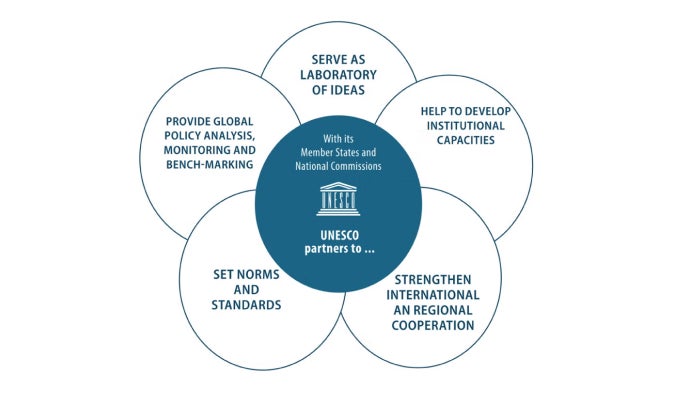
Through this Chair, UCLan Cyprus - HBKU align with UNESCO’s latest medium-term strategy to ‘help to develop regional capacities’, to ‘serve as a laboratory of ideas’, to ‘provide global policy analysis, monitoring, and benchmarking’, to ‘set norms and standards’, and to ‘strengthen international and regional cooperation’.
In addition, the Chair corresponds in a concrete manner to four of the 17 SDGs. These are the following:
SDG #4: Quality Education
The Chair will enhance existing and initiate new postgraduate programs that emphasize the need for good governance principles and socially responsible projects to safeguard the integrity of sport.
SDG #5: Gender Equality
The Chair will take specific steps to support the participation and empowerment of women in all forms of sport through various educational and training programs, research initiatives, and internships.
SDG #16: Peace, Justice, and Strong Institutions
The Chair will strengthen governance systems in sport to foster social integration in different cultural and political contexts, aligning with the goal of promoting peace, justice, and strong institutions.
SDG #17: Partnerships for the Goals
The Chair has established influential partnerships at national and international levels to build capacity in education and training, research, policy development, and publishing, aligning with the goal of fostering partnerships for sustainable development.
The Chair is also aligned with the Kazan Action Plan adopted by sports ministers across the globe back in 2017, which has as one of the main policy areas the safeguarding of the integrity of sport and five actions that have sports governance at their core.
Finally, it is also aligned with the latest (2023-2030) Strategic framework of Qatar’s Olympic Committee, highlighting areas, principles, and values that this Chair plans to address and be guided by.
Official Documents
UNESCO Chair Governance and Social Responsibility in Sport Program Agreement
Support Letters provided by the Rector of UCLan Cyprus
Support Letters provided by the Dean of CSE-HBKU
Support Letters provided by the relevant national commissions (Cyprus and Qatar)
The Terms of Reference for the Advisory Committee: Terms of Reference